
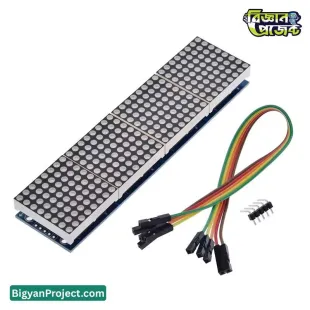
- On sale!
- -৳111
- New
 Science Projects
 Sensor & Modules
 Basic Components
 Development Boards
 Robotic Parts
 Drone Parts
 Tools & Accessories
 Power Sources
 Kits & Combo
 IC & Microchip
 Cables & Connectors
 Audio Components
The Dot Matrix Display category includes LED matrix modules such as 8x8 MAX7219 boards and larger P10 panels widely used in Arduino, ESP32 and microcontroller projects. These displays are ideal for scrolling text, numeric data and simple graphics in electronic and robotics applications.
There is 1 product.
The Dot Matrix Display is one of the most useful visual output devices in electronics learning. It allows a microcontroller to show letters, numbers and simple graphics in a clear and attractive way. Students in Bangladesh frequently use this display in school science fairs, college projects and university level embedded systems courses. At Bigyan Project (বিজ্ঞান প্রজেক্ট), this category collects different types of LED matrix displays so learners can easily find the correct module for their project without confusion.
A dot matrix display is an LED based panel made of multiple small LEDs arranged in rows and columns. Each LED is a single pixel. When a microcontroller controls the pixels in a specific pattern, it forms characters, scrolling text or animations. Because every pixel is individually addressable, it is perfect for teaching display control, multiplexing and basic graphics programming.
Compared to seven segment displays, a dot matrix can show alphabets and symbols, not only numbers. This is why it is very popular in educational robotics and embedded programming.
The most commonly used module for beginners is the 8x8 LED matrix with MAX7219 driver. It is simple to connect and works directly with Arduino and ESP32. Students can display their name, ID number, temperature value or a welcome message on their project.
Larger displays like P10 LED panels are used when a project requires visibility from a distance. These are often used for digital notice boards, scoreboards and information boards in institutions. Many final year diploma and engineering projects in Bangladesh use P10 panels to build programmable LED boards.
Students choose dot matrix displays because they provide both learning value and visual impact. A project becomes more presentable when it can show real time data. For example, a temperature monitoring system can show the reading directly, a digital clock can display time, and a smart notice board can scroll messages.
It also helps students understand practical embedded concepts such as SPI communication, serial data transfer, shift registers, and memory mapping. These topics are part of robotics and microcontroller education.
Dot matrix displays are widely compatible with Arduino Uno, Nano, Mega, ESP8266 and ESP32 development boards. Most modules only require three or four signal wires and a power connection. Many open source libraries are available, so beginners can quickly run example programs and then modify them for their own science project.
At Bigyan Project, students often buy this display together with Arduino boards, jumper wires and sensors to build a complete project setup.
Students and hobbyists in Bangladesh commonly build a digital clock, scrolling name display, smart classroom notice board, temperature and humidity monitor, RFID attendance system and IoT information display. A dot matrix module allows the project to communicate information visually instead of only using LEDs or buzzers.
Because of its low power consumption and simple programming, it is suitable for battery powered and portable projects as well.
Working with a dot matrix display improves programming logic and hardware understanding. Learners understand how characters are stored in memory and how patterns form images. It is a practical introduction to graphics rendering and display interfacing. These skills are useful for robotics competitions, science fairs and university engineering coursework.
For beginners, an 8x8 MAX7219 matrix is recommended because wiring and coding are straightforward. For large visibility or institutional projects, P10 LED panels are more suitable. If a project requires multiple modules, they can be chained together to create a longer display area.
Bigyan Project (বিজ্ঞান প্রজেক্ট) provides modules suitable for beginners as well as advanced learners, so students can start small and later upgrade their project without changing the learning platform.
Dot matrix displays are widely used in coaching centers, mosques, shops, laboratories and educational institutes for information display. This real life usage makes student projects more practical and relatable. Many students build working prototypes that can actually be used in their school or local community.
Students often look for easy wiring guidance and example codes. Educational sellers like Bigyan Project help learners by providing compatible components and project ideas so beginners do not get stuck at the hardware selection stage. A proper display module makes the learning experience faster and more enjoyable.
Searchable Keywords: dot matrix display, LED matrix display, 8x8 led matrix, MAX7219 module, P10 LED panel, Arduino display module, ESP32 LED matrix, scrolling text display, student science project electronics, robotics display module Bangladesh, DIY electronics display board
check_circle
check_circle